Why Cant You Form Wood Again From Ash
3.7: Conservation of Mass - There is No New Matter
- Page ID
- 161827
It may seem every bit though called-for destroys matter, simply the same amount, or mass, of matter nonetheless exists after a bivouac as before. Wait at Figure \(\PageIndex{1}\) below. It shows that when wood burns, it combines with oxygen and changes not only to ashes, but also to carbon dioxide and h2o vapor. The gases float off into the air, leaving behind just the ashes. Suppose you had measured the mass of the forest before it burned and the mass of the ashes afterwards it burned. Also suppose you had been able to measure out the oxygen used by the fire and the gases produced by the fire. What would you find? The full mass of matter after the burn down would exist the aforementioned equally the total mass of matter before the fire.
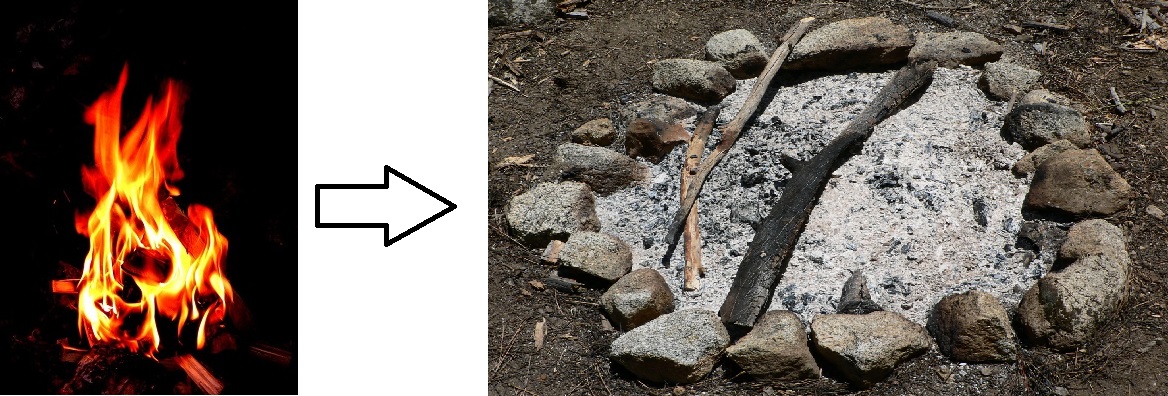
Police force of Conservation of Mass
The law of conservation of mass was created in 1789 by a French chemist, Antoine Lavoisier. The police of conservation of mass states that matter cannot be created or destroyed in a chemical reaction. For example, when wood burns, the mass of the soot, ashes, and gases equals the original mass of the charcoal and the oxygen when information technology first reacted. So the mass of the product equals the mass of the reactant. A reactant is the chemical reaction of 2 or more elements to make a new substance, and a product is the substance that is formed equally the event of a chemical reaction (Video \(\PageIndex{1}\)). Matter and its corresponding mass may non be able to be created or destroyed, but tin change forms to other substances like liquids, gases, and solids.
If you witness a 300 kg tree burn down to the footing, there are simply ashes left after the burn down, and all of them together counterbalance 10 kg. It may make you wonder where the other 290 kg went. The missing 290 kg was released into the atmosphere as fume, so the only thing left that you can come across is the 10 kg of ash. If you know the police of conservation of mass, and then you know that the other 290 kg has to get somewhere, considering it has to equal the mass of the tree before it burnt downwards.
Example \(\PageIndex{i}\)
If heating x.0 grams of calcium carbonate (CaCO3) produces 4.4 grand of carbon dioxide (COtwo) and v.6 g of calcium oxide (CaO), prove that these observations are in understanding with the law of conservation of mass.
Solution
\[\begin{marshal*} \text{Mass of the reactants} &= \text{Mass of the products} \\[4pt] x.0\, \text{yard of } \ce{CaCO3} &= 4.4 \,\text{thou of }\ce{CO2} + 5.6\, \text{g of } \ce{ CaO} \\[4pt] ten.0\,\text{k of reactant} &= 10.0\, \text{1000 of products} \stop{marshal*}\]
Because the mass of the reactant is equal to the mass of the products, the observations are in agreement with the law of conservation of mass.
Exercise \(\PageIndex{1}\)
Potassium hydroxide (\(\ce{KOH}\)) readily reacts with carbon dioxide (\(\ce{CO2}\)) to produce potassium carbonate (\(\ce{K2CO3}\)) and water (\(\ce{H2O}\)). How many grams of potassium carbonate are produced if 224.four g of \(\ce{KOH}\) reacts with 88.0 g of \(\ce{CO2}\)? The reaction also produces 36.0 yard of water.
- Answer
- 276.iv thousand of potassium carbonate
The Police is also applicable to both chemical and physical changes. For example, if y'all accept an water ice cube that melts into a liquid and you heat that liquid upwards, information technology becomes a gas. It will appear to accept disappeared, but is all the same there.
Summary
- Burning and other changes in affair do not destroy affair.
- The mass of matter is always the same before and after the changes occur.
- The law of conservation of mass states that affair cannot be created or destroyed.
Contributions & Attributions
This folio was synthetic from content via the following contributor(southward) and edited (topically or extensively) past the LibreTexts development team to meet platform style, presentation, and quality:
-
Binod Shrestha (University of Lorraine)
-
Marisa Alviar-Agnew (Sacramento City Higher)
-
Henry Agnew (UC Davis)
Source: https://chem.libretexts.org/Courses/can/intro/03:_Matter_and_Energy/3.07:_Conservation_of_Mass_-_There_is_No_New_Matter
0 Response to "Why Cant You Form Wood Again From Ash"
Post a Comment